
This is ISRO's new record of launching 20 satellites, including those from the US, Germany, Canada and Indonesia.

The Indian Space Research Organisation successfully launched India's fifth navigation satellite IRNSS-1E from Sriharikota.

The year ended with the launch of the PSLV's 50th mission.

According to ISRO officials, the spacecraft will be placed in a halo orbit around Lagrange point 1 (L1) of the Sun-Earth system, about 1.5 million km from the Earth. The L1 point is about one per cent of the total distance between the Earth and the Sun.

India's Polar Satellite Launch Vehicle will lift off from Sriharikota on July 10 taking five foreign satellites into orbit, including three earth observation spacecraft whose imagery will be utilised by a Beijing-based company as well as an experimental nano-satellite that will deploy a large, light-weight sail in order to hasten its descent back to earth.

The Indian Space Research Organisation (ISRO) will perform the final manoeuvre on Saturday to inject Aditya-L1 spacecraft -- the first space-based Indian observatory to study the Sun -- into its final destination orbit, some 1.5 million kilometres from the Earth.
Prime Minister Narendra Modi lauded the scientists saying, "with this successful launch, we will determine our own paths powered by our technology".
The stage is set for the launch of India's satellite IRNSS-1D on Saturday from Sriharikota onboard workhorse PSLV-C27 that would pave the way for the country's own navigation system on par with the GPS of United States.

Aditya L1, the first space based Indian mission to study the Sun underwent the second earth-bound manoeuvre successfully, during the early hours on Tuesday, Indian Space Research Organisation (ISRO) said.
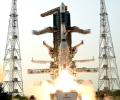
Over 32 missions -- satellites and rockets -- have been planned for the year.

Aditya-L1 is the first Indian space-based observatory that will study the Sun from a halo orbit around the first Sun-Earth Lagrangian point (L1), which is located roughly 1.5 million km from the Earth.

A quick recap of the Mars Orbiter Mission's major milestones on the way to Mars

India's Mars Orbiter Mission is slated to be launched on October 28 after a national committee of experts gave the go ahead for the Rs 450 crore ambitious venture after threadbare deliberations.

India scripted history by successfully launching EMISAT, a military satellite, and 28 foreign nano satellites on-board its polar rocket from Sriharikota on Monday, in a complex mission which marked many a first for Indian Space Research Organisation.

While the mission is a follow-up to the PSLV-C55 TeLEOS-2 mission launched in April this year, scientists in Sunday's mission will place the fourth stage of the PSLV rocket in a lower orbit.

India is set to operationalise its own navigational system with the successful launch of IRNSS-1D, the fourth in the series of seven navigational satellites, onboard PSLV-C27 from Sriharikota on Saturday.

ISRO, in a tweet, said EOS-04 was placed into an intended sun synchronous polar orbit of 529 km altitude at 6.17 am.
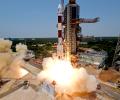
The successful launch of Aditya-L1 - the country's maiden mission to study the Sun - is expected to garner increased investor interest in the Indian space sector and trigger more funding for private players. Several private sector players, including Larsen & Toubro (L&T), MTAR Technologies, and Ananth Technologies, have played a pivotal role in the Indian Space Research Organisation's (Isro's) solar observatory mission. Aditya-L1 on Saturday set off on a 125-day journey on a PSLV-C57 rocket, in its attempt to study various elements relating to the nearest star from the halo orbit around Lagrange point 1 (L1) of the Sun-Earth system, which is about 1.5 million km from Earth.

The announcement comes two days ahead of the proposed historic launch of the ISRO's 100th satellite along with 30 others in a single mission from Sriharikota.

While the Mars mission got wide praise, there were voices which questioned the need for spending Rs 450-500 crore on it when the country is facing hunger and poverty.

Just over 22 minutes into the flight, the rocket put Astrosat into orbit at an altitude of 650 km above the earth

K Sivan has to hasten the effort to bring in private players into satellite and rocket building and replicate India's software success in aerospace.

The satellite would provide a thrust to mobile communication through multi-beam coverage facility, the ISRO said.

A US court has asked Antrix Corporation, the commercial arm of Indian Space Research Organisation, to pay a compensation of USD 1.2 billion to a Bengaluru-based startup, Devas Multimedia, for cancelling a satellite deal in 2005.

Godrej and some other firms are frustrated at what they say is the slow execution of projects and lack of government support, which are hampering India's efforts to compete with China and Russia as a cheaper option for launching satellites.

The Lagrange point 1 (L1) of the Sun-Earth system is about 1.5 million km from the Earth. It is about one per cent of the total distance between the Earth and the Sun.
'The goal seems to be that we do not invest further in our system to make our system more accurate and more reliable or more global in reach,' an ISRO source tells Shivanand Kanavi.

With the launch of GSLV-MK III, slated for April, it will be able to cater to bigger satellites as well.

Chandrayaan-3's success is a must for India's space ambitions; we can't afford to lose out. And for realising our space dreams, the Indian private sector must be encouraged because if we lose this race, the moon, Mars, and mineral-rich asteroids will already be crowded before we reach there.
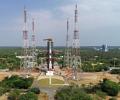
Days after landing on the Moon, India will aim for the Sun on Saturday with its maiden solar expedition, as ISRO's trusted PSLV will carry the Aditya L1 mission on a 125-day voyage to the Sun.

An industrial house bred in old-school manufacturing values, Godrej & Boyce has displayed unusual agility to become a trusted builder of advanced weaponry, discovers Ajai Shukla.

'India has got a unique opportunity to get more and more business from outside as India is cost-effective and reliable.'

India has made a good beginning in the area of satellite navigation but still there is a long way to go.

'Well begun is half done, today there are more hits than misses by the Modi government in its support towards science in India,' says Pallava Bagla.
'I will say all this happened because of ignorance coupled with arrogance,' says G Madhavan Nair.
 © 2026 Rediff.com - Advertise with us - Disclaimer - Privacy Policy - Sitemap - Feedback - About us - Terms of use - Grievances